Computer and Information SciencesGhost

Front Matter

Front Matter
The Front Matter Blog covers the intersection of science and technology since 2007.
Home PageAtom FeedMastodonISSN 2749-9952
language
FeatureComputer and Information Sciences
Published

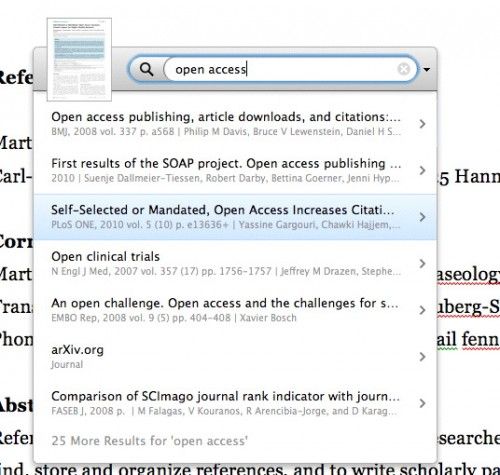
Ten days ago I mentioned a paper by Zhiyong Lu that gives an overview over the available web tools to search the biomedical literature. Most of these tools enhance the PubMed service, and Zhiyong Lu in fact works for the NCBI, the developer of PubMed. In this post I want to take a more detailed look at the available tools. A good starting point is the companion webpage to the paper, listing 28 services.
FeatureComputer and Information Sciences
Published

Zhiyong Lu recently published an excellent overview of the web tools that are currently available to search the biomedical literature. The article has also a companion web page that allows user to filter for the features they are interested in, and to report new tools. The author describes 28 tools developed specifically for the biomedical domain. The tools are grouped based on their most important features into 1. Ranking search results 2.

Meeting ReportComputer and Information Sciences
Published

On Monday I gave a presentation about ORCID, based on the ORCID Principles. The slides are hopefully a good introduction to ORCID and the current status of the initiative. A good in-person update of the ORCID initiative is the next ORCID Participant Meeting that takes place May 18 in Boston. Registration is free and everybody interested in unique identifiers for scholarly authors is invited to attend. More information at the ORCID website.

FeatureComputer and Information Sciences
Published

We are all familiar with digital object identifiers (DOIs) provided by CrossRef to identify (and link to) journal articles. Some of us are familiar with the DOIs issued by DataCite to link to datasets. But most of us don’t know that CrossRef is also providing component DOIs that can provide persistent links to a particular table or figure in a paper.

FeatureComputer and Information Sciences
Published

The history of HTML begins 1989 at CERN, the European Laboratory for Particle Physics in Geneva. Tim Berners-Lee, Robert Cailliau and colleagues invented HTML (as well as the transport protocol HTTP and the web browser) to facilitate collaboration between CERN physicists. HTML was originally invented for scholarly communication, but of course by the mid-1990s was also used by everybody else.

FeatureComputer and Information Sciences
Published

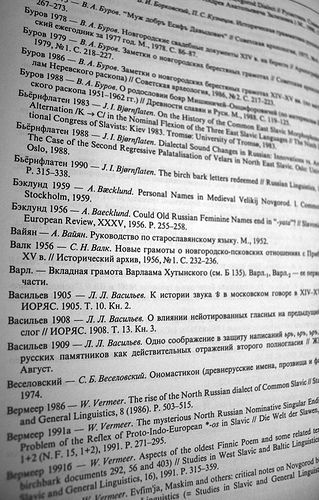
The bibliography of a scholarly paper is interesting and important reading material. You can see whether the authors have cited the relevant literature, and you often find references to interesting papers you didn’t know about. Bibliographies are obviously also needed to count citations, and then do all kinds of useful and not so useful things with them. Unfortunately almost all bibliographies are in the wrong format.

Science HackComputer and Information Sciences
Published

One of the annoyances with bibliographies as we use them for scholarly papers is that is usually unclear why a particular paper was cited. It is often possible for readers to gather this information by looking at the citation in the context of the surrounding text, but this is very difficult to automate.