ChemieEnglischWordPress

Henry Rzepa's Blog

Henry Rzepa's Blog
Chemistry with a twist
StartseiteAtom-Feed
language
Chemical ITOpendataSkolnikChemieEnglisch
Veröffentlicht

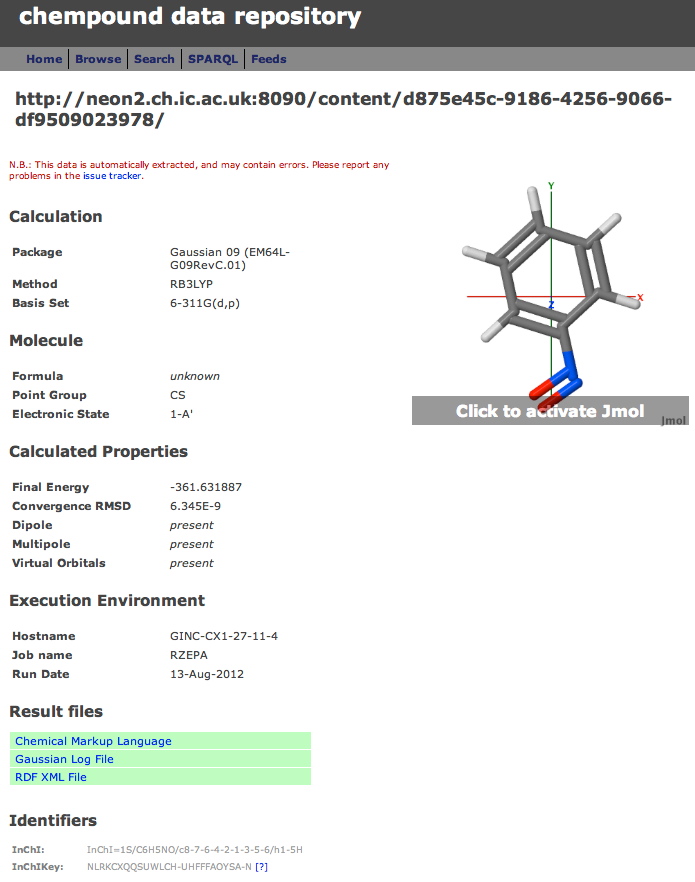
A third digital repository has been added to the two I described before. Chempound is a free open-source repository which (unlike DSpace and Figshare) was developed specifically for chemistry. It carries more semantic information (in the form of an RDF triple declaration), which allows SPARQL queries on the entry to be performed.

Reaction MechanismTutorial MaterialWittig ReactionChemieEnglisch
Veröffentlicht

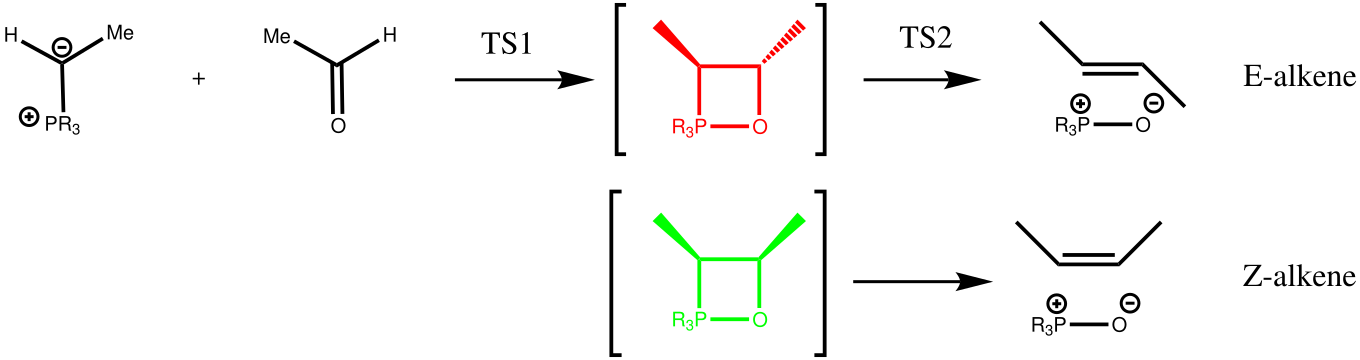
This is another of those textbook reactions, involving reaction of a carbonyl compound with a phosphonium ylid to form an alkene and a phosphine oxide. The reaction continues to be frequently used, in part because it can be highly stereospecific.  Thus the standard version tends to give Z -alkenes with good specificity, and is thought to proceed via an oxaphosphatane 4-ring intermediate.

EliminationMigrationPericyclicReaction MechanismTutorial MaterialChemieEnglisch
Veröffentlicht

The Curtius reaction is represented in most chemistry texts and notes as following path (a) below. It is one of a general class of thermally induced rearrangement which might be described as elimination/migration (in a sense similar to this ring contraction migration/elimination), in this case implicating a nitrene intermediate if the two steps occur consecutively.

Curly ArrowsDeficiencyIntrinsic Reaction CoordinateReaction MechanismTutorial MaterialChemieEnglisch
Veröffentlicht

Two years ago, I discussed how curly arrow pushing is taught, presenting four different ways of showing the arrows. One of the comments posted to that blog suggested that all of the schemes shown below were deficient in one aspect. Curly arrow pushing The issues were the stereo and regiochemistry. In particular, the diagram above carries no explicit information about the symmetry of the electrons from which the first arrow originates;

Dimer ProductIPadPericyclicPostscriptPotential Energy SurfaceChemieEnglisch
Veröffentlicht

organic chemistry. It does not look like much, but this small little molecule brought us ferrocene, fluxional NMR, aromatic anions and valley-ridge inflexion points. You might not have heard of this last one, but in fact I mentioned the phenomenon in my post on nitrosobenzene. As for being at a crossroads, more like a Y-junction. Let me explain why.

Curly ArrowsInteresting ChemistryFree Energy Activation BarrierHistoricalΣ/π OrthogonalityChemieEnglisch
Veröffentlicht

Recollect, Robinson was trying to explain why the nitroso group appears to be an o/p director of aromatic electrophilic substitution. Using σ/π orthogonality, I suggested that the (first ever) curly arrows as he drew them could not be the complete story, and that a transition state analysis would be needed. Here it is.  Let me set the scene on how this might be done.

Chemical ITDigital Eco-systemsInChI StringIPadIPhoneChemieEnglisch
Veröffentlicht

A month or so ago at a workshop I was attending, a speaker included in his introductory slide a QR (Quick Response) Code. It is a feature of most digital eco-systems that there is probably already “an app for it”. So I thought I would jump on the band wagon by coding an InChI string. Here it is below: QRCode for an InChI string. Point your smart device at it, and see the InChI appear!

Chemical ITAPIChemspiderComputational ChemistryDigital RespositoryChemieEnglisch
Veröffentlicht

I blogged about this two years ago and thought a brief update might be in order now. To support the discussions here, I often perform calculations, and most of these are then deposited into a DSpace digital repository, along with metadata. Anyone wishing to have the full details of any calculation can retrieve these from the repository. Now in 2012, such repositories are more important than ever.

Curly ArrowsLower Energy Transition StateMonty PythonNitroPotential Energy SurfacesChemieEnglisch
Veröffentlicht

The discussion appended to the post on curly arrows is continued here. Recollect the curly arrow diagram (in modern style) derived from Robinson’s original suggestion: The pertinent point is that the angle subtended at the nitrogen atom evolves from being bent (~115°) on the left, to linear (180°) on the right.

Curly ArrowsDimerReaction MechanismTutorial MaterialChemieEnglisch
Veröffentlicht

Little did I imagine, when I discovered the original example of using curly arrows to express mechanism, that the molecule described there might be rather too anarchic to use in my introductory tutorials on organic chemistry. Why? It simply breaks the (it has to be said to some extent informal) rules!