PapersBiosecurityAI
Published in Paired Ends
Author Stephen Turner
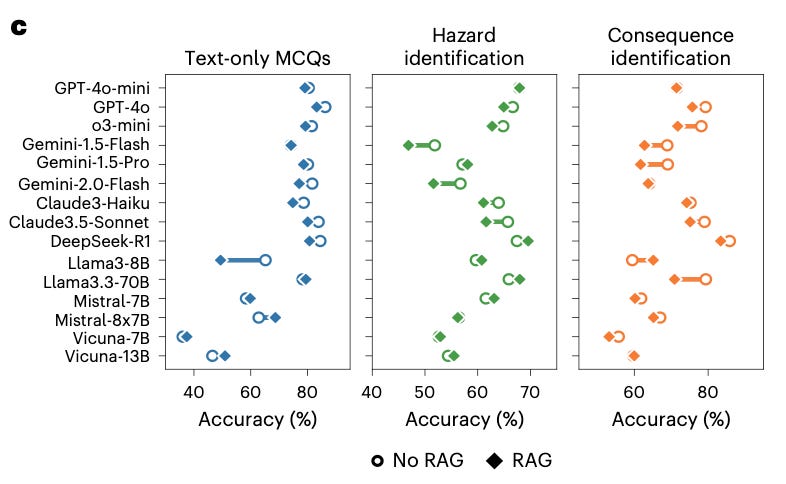
A laboratory safety benchmark finds retrieval augmented generation (RAG) can make strong models worse.
A laboratory safety benchmark finds retrieval augmented generation (RAG) can make strong models worse.
Like many awesome internet phenomena, blogging started in the late nineties. Nature authors and editors recognized the effort early. In 2006 there were already more than 45 million blogs, and at least 50 science blogs made it in the top 50,000 and 5 in the top 3,500.
I’m still making my way through Brian Curtice’s excellent and detailed post on Greg Paul’s (2025) recent erection of a new titanosaur genus (Curtice 2025), but I just want to comment on this one passing thought of Brian’s: The species tells me where it was found if named by “Old Timers,” the genus almost can […]
Die Kreativität im KI-Zeitalter steht vor einer wichtigen Herausforderung: Einerseits sind die KI-Modelle hungrig nach immer neuen Trainingsdaten, mit möglichst viel Schöpfungshöhe. Andererseits pochen die Urheberinnen dieser Daten bzw. die Inhaber der Rechte an den Daten auf eine angemessene Vergütung. Eine neue Initiative namens „Really Simple Licensing“, abgekürzt RSL, verheißt eine unkomplizierte Lösung.

Deux chercheurs français viennent de publier les résultats d’une enquête en ligne diffusée dans trois départements d’Occitanie une semaine après une vague de chaleur durant l’été 2022. Jusqu’ici, nous manquions cruellement d’informations quantitatives sur les comportements qui sont adoptés pour faire face à la chaleur en France.
Data and knowledge originating from heterogeneous sources often use heterogeneous controlled vocabularies and/or ontologies for annotating named entities. Semantic mappings are essential towards resolving these discrepancies and integrating in a coherent way.
AIxBio, biotech 2025, Claude Code, Positron tips, cell fate engineering, academic slop, AI in health & life sciences research, R updates (R Data Scientist, R Weekly), RAG in R, papers &
Appalachian History Series – Houston Coal Company Store: Carswell Hollow’s Company Town Front Porch If you come into Kimball along U.S. 52, the coal camp at Carswell does not look like much at first glance. The hollow narrows quickly, the creek runs tight against the road, and the Norfolk Southern tracks hug the opposite bank.
Appalachian History Series – Consolidation Coal in Appalachia: Land, Labor, and Life in Jenkins and Van Lear When the Consolidation Coal Company first incorporated in Maryland during the Civil War era, its managers were thinking about the bituminous seams of the Georges Creek basin and the rail connections that could move that coal to eastern cities.
Appalachian History Series – Blue Diamond Coal Company: From First Creek to Scotia and Stearns On a March morning in 1976, the name Blue Diamond Coal Company suddenly appeared in headlines far from the mountains. Two methane explosions at the Scotia Mine in Letcher County killed twenty six men over the course of three days and put a relatively quiet Knoxville based coal firm under a national spotlight.